Find out which ASIC miners will impress with their power and efficiency in 2026: Bitmain Antminer S21 Pro, U3S23H, MicroBT Whatsminer M79S, Canaan A16 XP, iPollo, and others. We discuss electricity rates, profitability, alternative coins, and wallet security.
🎯 What’s going on in the mining industry without numbers in the headline?
You won’t believe it, but let’s start without a pompous introduction, and instead with a straightforward question: what’s the ASIC mining world like in the middle of the decade? It’s useful to grasp the nuances, because it’s not just “plug and mine.” Network difficulty is rising, rewards have halved, and old mining rigs are already gathering dust. In the energy tsunami, only those with the lowest electricity bills are surviving. This symphony of change is seeing the emergence of new predators like the Antminer S21 Pro and Whatsminer M79S , as well as sprinters from iPollo and Canaan. And all of this is a prelude to our discussion of what’s next.
ASIC vs. GPU: An Eternal Duel with New Rules
In 2026, the eternal “ASIC vs. GPU” debate is no longer a matter of simple arithmetic. Even gamers who wander onto mining forums discuss water cooling and kWh prices. According to Crypto-Mining.blog , the Antminer S21 Pro produces approximately 234 TH/s with an energy efficiency of approximately 15 J/TH and consumes ~3.5 kW. At $0.06 per kWh, such a giant brings in approximately $8 per day, but if electricity rises to $0.12, profitability evaporates. A hypothetical farmer using expensive European energy sees a loss instead of a profit.
An alternative is the MicroBT WhatsMiner M60S – a reliable machine capable of 170–186 TH/s with an efficiency of ~18.5 J/TH. It’s popular with large mining rigs, although there are fewer third-party firmware versions available. There’s also the Canaan Avalon A1566 , which delivers 185 TH/s with less impressive efficiency. And if you’re dreaming of water cooling, check out the Antminer S23 Hydro and SealMiner A2 Pro Hydro : the S23 Hydro’s record-breaking 9.5 J/TH makes it a “sports car among trucks.”
GPU miners are naturally skeptical: can’t the RX 580 or RTX 3070 hold their own? But it must be said: for coins based on the SHA-256 and Scrypt algorithms , ASICs remain king. Crazy-Mining.org emphasizes that older Antminer S9 and Whatsminer M32 models survive only thanks to the rising BTC price; as soon as network difficulty soars, these “veterans” will be shelved.
🌊 New wave of hardware: U3S23H, M79S, and other beasts
If classic models seem trivial to you, take a look into the future. HashrateIndex lists the latest ASIC monsters:
- The Bitmain Antminer U3S23H (Hydro) is a true water dragon. This beast produces 1,160 TH/s with a phenomenal energy efficiency of 9.5 J/TH and consumes approximately 11 kW. First deliveries are expected in February 2026, and the daily profit at a rate of $0.06 per kWh is estimated at $27.50.
- The MicroBT Whatsminer M79S (Hydro) is a slightly less powerful competitor with 930 TH/s and 13.5 J/TH efficiency; it was announced at the Bitcoin MENA conference in December 2025. The manufacturer has not yet announced a shipping date, but the price target is $25–30 per TH.
- The Canaan Avalon A16 XP is the air-cooled flagship of the A16 lineup: 300 TH/s at 12.8 J/TH; first shipments are expected in March 2026.
- MicroBT Whatsminer M70S+ is the leader of the new M70 series: 244 TH/s and energy efficiency of 12.5 J/TH.
Why do I need to know all this? Because the ASIC market is changing rapidly: vendors are striving for petahash-powered machines, and miners, realizing that “more” isn’t always “better,” are balancing power and cooling costs. Water-cooled devices are quieter and cooler, but require infrastructure. Air-cooled devices are simpler, but they’re noisy and hot. And somewhere in the distance, the Whatsminer M66S (Immersion) with 298 TH/s, designed for immersion in liquid, is winking.
Energy is more valuable than gold: tariffs decide everything
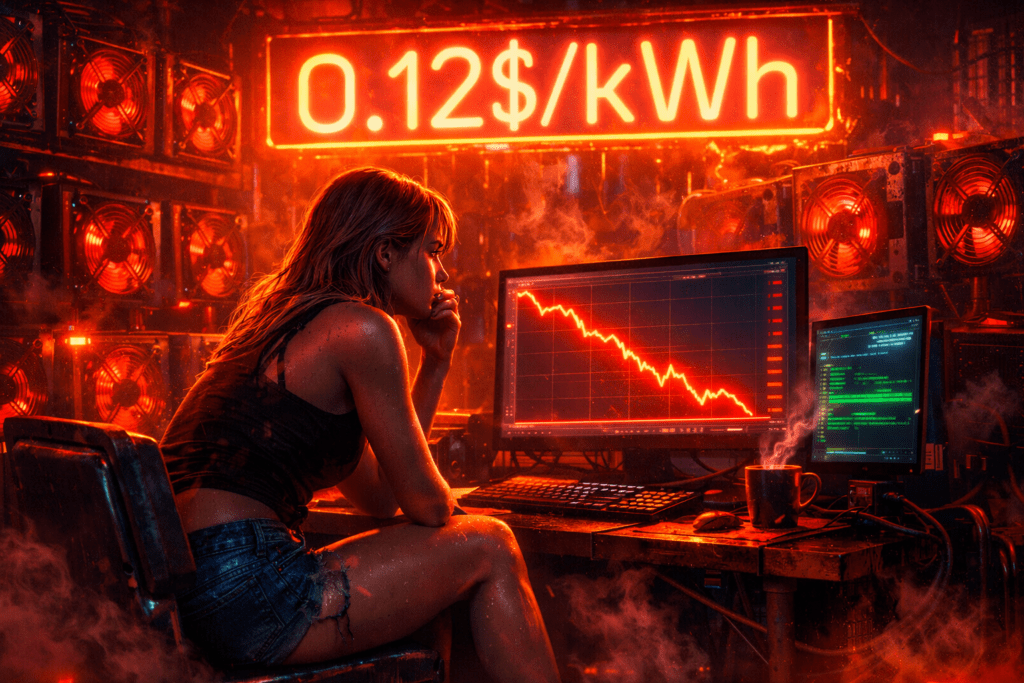
People often think that mining profits depend solely on the Bitcoin price. In reality, energy prices have become the “new oil.” Crypto-Mining.blog warns that at $0.12 per kWh, even the latest ASICs go into the red, and at $0.15–0.20, the breakeven point simply disappears. Therefore, mining farms are moving to Iceland, Canada, and Kazakhstan—where electricity is cheap and “green.” Analysts at the US Energy Administration predict wholesale prices will rise to $51 per MWh (≈$0.051 per kWh), an 8.5% increase by 2026. Miners are forced to enter into long-term contracts, invest in solar power plants, and even share heat with greenhouses or museums.
Besides pricing, joules per terahash are also important . According to Crazy-Mining.org , the best SHA-256 devices consume 15–20 J/TH, while video cards only provide 2 MH/W, making them ineffective for BTC mining. This difference explains why people buy specialized chips: with the network’s rapidly growing complexity, every joule is worth saving.
🛠️ How to calculate payback and reduce risks
Cold, mathematical calculation is the foundation of survival. Crazy-Mining.org offers a simple method: payback (in months) = equipment cost / monthly profit. It’s wise to build several scenarios—optimistic, realistic, and pessimistic. In 2025–2026, at a tariff of $0.045 per kWh and a BTC price of ~$130,000, the payback period for top-end ASICs could be 25–30 months; at higher tariffs, profitability drops to zero. Secret life hacks:
- AI and automation . Artificial intelligence is predicted to optimize ventilation, distribute hashrate across pools, and even predict temperatures—resulting in savings of up to 25%.
- Regional migrations . Miners move to places where electricity is cheap and reliable.
- Firmware updates . Built-in firmware often limits potential. For example, for the Antminer S21 XP Hydro, third-party firmware from Luxor (LuxOS) increases efficiency by 8.5% when underclocked and provides up to an 11.5% hashrate boost when overclocked.
- Diversification . Combine ASICs and GPUs for different coins: during a crisis, switch to Kaspa, Alephium, or Nexa, where the entry barrier is lower.
🤔 What to mine besides Bitcoin
Bitcoin remains the flagship, but it’s not the only scene. Litecoin and Dogecoin (Scrypt algorithm) are mining together; the Antminer L7 remains the leader with 9.5 GH/s and ~3.5 kW of power. By 2025, the older L3+ will no longer be profitable. For Equihash coins like Zcash, the Antminer Z15 Pro remains ideal with 840 KSol/s and 2.57 kW. Meanwhile, newcomers Kaspa , Alephium , and Nexa are attracting attention with their block speed and hybrid algorithms. Kaspa generates blocks every second, and its fees are reduced monthly, making the project attractive but risky. Therefore, as analysts suggest, it’s important not to put all your eggs in one basket.
🔐 Wallets and Security: Store Your Earnings Properly
Even the most nimble mining farms are useless if you lose your income due to a hack. Crypto-wallets.org and cool-mining.org recommend using Atomic Wallet , Electrum Dogecoin , and similar lightweight wallets for everyday funds. Electrum Dogecoin , for example, is a lightweight SPV wallet: it launches quickly, doesn’t overload your disk, and leaves your private keys in your possession. However, some trust is transferred to the servers: lightweight wallets balance convenience and control. In thematic selections on these sites, lightweight wallets are called the “golden mean” between convenience and autonomy, especially for those who don’t want to store the full blockchain. In any case, download your wallet only from official sources and save your seed phrase offline—advice that saves money more often than you might think.
What about iPollo?
We’ll briefly mention iPollo , a company that produces compact ASICs for home miners. In 2025, they attracted attention with the iPollo V2H Hydro , designed for mining Ethereum Classic and other Ethash coins. This new product combines hydrocooling and relatively quiet operation, making it suitable for garage installation. While specific specifications are scarce in open sources, rumors suggest a power output of around 1.5 GH/s and a consumption of around 1 kW. Its emphasis on ergonomics and low noise makes iPollo a choice for home enthusiasts, but professional miners are currently more interested in products from Bitmain and MicroBT.
🧠 Final thoughts
Looking at the ASIC miner market in 2026, you realize that the era when it was enough to buy an Antminer S9 and wait for the moon is over. Mining now requires strategy, the ability to read energy reports, and the use of engineering innovations. New models like the U3S23H and M79S are impressive in scale, but will require enormous capital investment and infrastructure. Home miners can opt for quieter options or switch to GPU-based coins.
My personal recommendation? Focus on flexibility and education. Follow the news at crazy-mining.org , crypto-mining.blog , cool-mining.org , and crypto-wallets.org , keep an eye on innovation, and don’t ignore “boring” topics like electricity contracts or fan settings. And if you ever feel tired of numbers, remember that the world of PoW is alive thanks to people who aren’t afraid to experiment.
🔗 Links to sources
- – a review of profitable ASIC miners for 2026, tips on calculating profitability, and recommendations for choosing cryptocurrency wallets.
- crypto-mining.blog – analysis of Bitcoin network difficulty, electricity rates, and comparison of the S21 Pro, M60S, and S23 Hydro models.
- – A guide to lightweight Electrum Dogecoin wallets, the benefits of SPV wallets, and security tips.
- – mining software reviews, safe storage recommendations, and links to lightweight wallets (mentioned in the Electrum Dogecoin article).
Read more:
 Top cryptocurrencies for mining on a budget – a review of coins, algorithms, and hardware

 A Review of the Most Profitable GPU Mining Algorithm in 2026
  Firmware Awesome Miner for Antminer (Download Firmware ASIC)
 Overview of Bitmain Antminer X3 CryptoNight ASIC Miner